
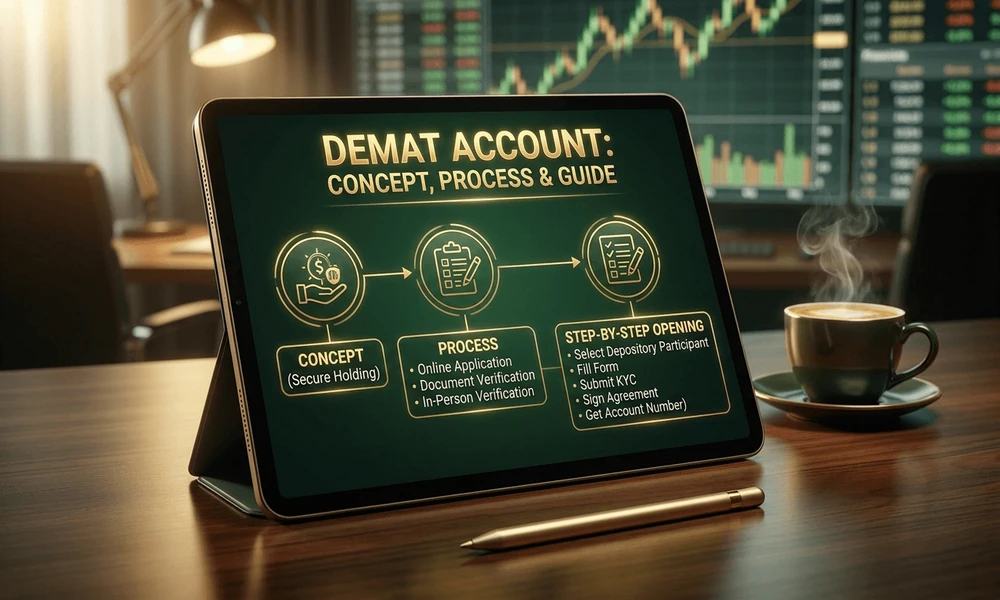

A Demat Account is used to hold eligible securities electronically, making it easier to manage ownership records without physical certificates. While opening the account is an important first step, the longer-term experience depends on how clearly holdings, transactions, statements, charges, settlement details, and security features are managed.
Investors should therefore look beyond account-opening convenience. A useful demat setup should support accurate record-keeping, transparent costs, secure access, and easy coordination with the trading and bank accounts linked to the investment process.
The Main Role Is Electronic Ownership
The core function of a demat account is to hold eligible securities in electronic form.
Depending on the platform and supported products, holdings may include:
- Listed shares
- Exchange-traded securities
- Other eligible instruments
The demat account is therefore primarily an ownership record.
It should not be confused with the trading interface used to place market orders.
Trading and Demat Functions Work Together
A trading account generally supports buying and selling.
The demat account generally stores eligible securities after settlement.
The two may appear within one platform, but they perform different functions.
This distinction becomes useful when reviewing:
- Orders
- Positions
- Holdings
- Settlement status
Understanding these categories can prevent confusion after a transaction is executed.
Settlement Determines When Holdings Are Updated
An executed delivery-based trade does not always appear immediately as a settled holding.
Settlement processes determine when securities and funds are transferred.
Users should therefore distinguish between:
- Successful order execution
- Settlement completion
- Final holdings visibility
This helps explain why recently purchased securities may appear differently across order, position, and holdings sections.
Charges Should Be Reviewed Beyond Account Opening
Some users focus mainly on whether account opening is free.
Ongoing costs can matter more over time.
Depending on the provider and account structure, users may encounter:
- Account maintenance charges
- Depository-related charges
- Transaction-related charges
- Other applicable service costs
The complete schedule of charges should be reviewed before significant assets accumulate in the account.
Statements Should Be Easy to Access
Official statements can help investors verify their holdings and transactions.
Useful records may include:
- Security name
- Quantity
- Debit activity
- Credit activity
- Transaction history
Investors should know where statements are available and how frequently they are issued.
These records can provide useful confirmation beyond the main portfolio screen.
Online Mutual Funds Investment Uses a Different Investment Structure
Online Mutual Funds Investment may be available through the same financial platform, but mutual fund transactions should not automatically be treated as identical to direct securities held in demat form.
The holding structure can depend on the platform and product arrangement used.
Investors should understand:
- Where the investment is recorded
- How units are held
- Where statements are available
This reduces confusion when different asset types appear in the same app.
Security Should Be Treated as a Long-Term Requirement
A demat account may contain securities accumulated over many years.
Strong security practices should therefore include:
- Secure passwords
- Verified authentication
- Device protection
- Regular activity checks
OTPs, PINs, and passwords should never be shared with unknown individuals or unofficial support channels.
Security becomes more important as portfolio value grows.
Nomination and Personal Details Need Maintenance
Account administration should not end once the account is activated.
Users should periodically review:
- Nomination details
- Mobile number
- Email address
- Bank information
- Other account records
Keeping these details current can reduce problems when account servicing is required later.
Holdings Should Be Reviewed for Concentration
A demat account may display several securities and still contain significant concentration.
For example, five holdings may all belong to the same sector.
Investors should therefore look beyond the number of positions and examine:
- Sector exposure
- Company exposure
- Position size
- Portfolio weight
The account records ownership, but investors remain responsible for portfolio construction.
Corporate Actions Can Change the Holding Record
Listed companies may carry out corporate actions such as:
- Dividends
- Stock splits
- Bonus issues
- Rights-related actions
These may affect holdings or investor entitlements.
Users should monitor official company communications and account records so that changes are understood correctly.
Transfers Should Be Checked Carefully
Investors may sometimes need to move eligible securities between demat accounts.
- Security selected
- Quantity
- Destination details
- Applicable process
- Charges, if any
Incorrect information can cause delays or complications.
Transfers should always use authorised channels.
Dormant Accounts Still Need Attention
Some long-term investors may place very few transactions.
Even when trading activity is low, the demat account should still be reviewed periodically.
Useful checks include:
- Are holdings accurate?
- Are statements accessible?
- Are contact details current?
- Are login credentials secure?
Infrequent activity should not result in neglecting account administration.
Customer Support Can Matter During Account Issues
Support becomes particularly important when users face problems involving:
- Holdings
- Charges
- Statements
- Account access
- Transfers
Official support channels should be clearly available.
A provider with a simple interface but weak support may become difficult to deal with when a more complex account issue arises.
App Design Should Prioritise Record Clarity
A useful demat interface should make it easy to locate:
- Holdings
- Transactions
- Statements
- Account information
- Service requests
The account may be used for many years.
A clean structure therefore matters more than temporary visual features or promotional design.
Demat Does Not Reduce Market Risk
A demat account provides electronic custody and record-keeping.
It does not protect the investor against:
- Falling share prices
- Company-specific problems
- Sector weakness
- Market volatility
Investment risk depends on the securities held and how the portfolio is structured.
Account infrastructure and investment quality are separate issues.
Broking Connects the Account to Market Execution
Broking services generally provide the market-access layer through which eligible buy and sell orders are placed.
The demat account then works alongside that trading relationship by holding eligible securities after settlement.
Users should understand both functions so that order execution, holdings, charges, and account records remain easier to interpret.
Conclusion
A Demat Account should be evaluated as a long-term ownership and record-management system, not merely as an account-opening requirement.
Investors should review charges, settlement visibility, statements, security, nomination details, transfer processes, customer support, and the connection between trading and demat functions.
The strongest setup is one that keeps ownership records clear, account access secure, and long-term portfolio administration easy to manage.
FAQs
1. What is a Demat Account?
A Demat Account is an account used to hold eligible securities electronically instead of through physical certificates.
2. Is a Demat Account the same as a trading account?
No. A trading account is generally used for placing market orders, while a demat account holds eligible securities electronically.
3. Why should investors review demat charges?
Ongoing account and transaction-related charges can affect the total cost of maintaining and using the account.
4. Why are demat statements useful?
They help investors verify holdings, transactions, and account activity independently of the main app interface.
5. Does a demat account make investing less risky?
No. It improves electronic ownership and record management, but market risk still depends on the investments held.